
Calibration
Does the model’s confidence match what actually happens? We compare predicted yield, marketable life and likely diagnoses with measured results.
Home / Research
Our research asks one question: can agricultural advice be trusted when it matters? We study it with farmers, extension workers and researchers, and we judge it by what happens in the field.
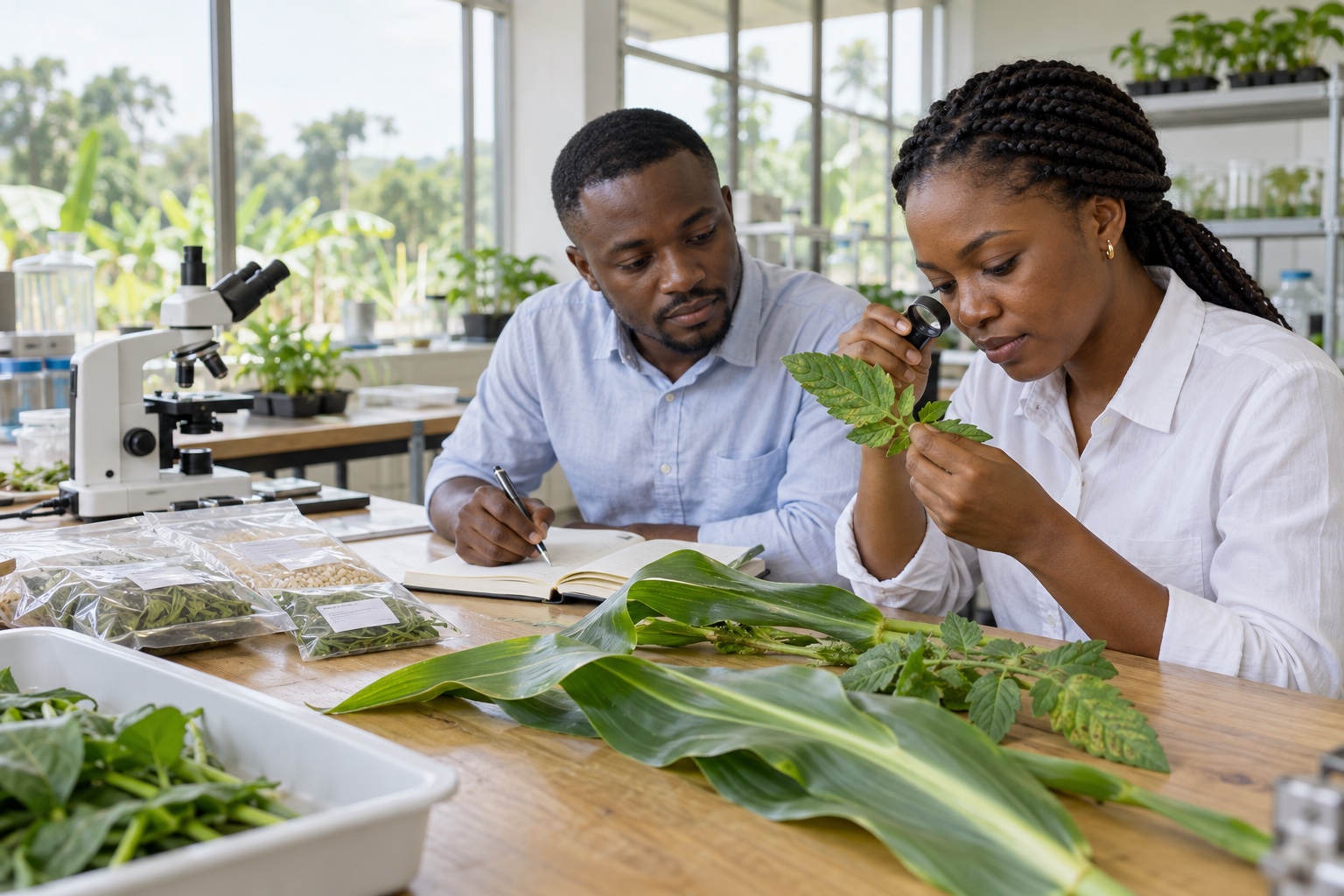
Five questions shape our work. Each one is studied in the field, not only in the lab.
Does the model’s confidence match what actually happens? We compare predicted yield, marketable life and likely diagnoses with measured results.
When should advice defer to a person? We study how uncertainty is detected, explained and routed to agronomists and extension workers.
How much does context improve advice? We test what difference crop, planting date, growth stage and recent work make to a recommendation.
What works on a low-cost phone on an unstable network? We study offline capture, retry without duplicates, and simple interactions.
How well does advice fit local crops and practice? Our work considers cassava, tomato and maize, alongside the language and practical context of the farmer.
Go deeper
Choose a question to see how we study it and what we look at.
Calibration
We compare predicted yield, marketable life and likely diagnoses with measured results.
Human oversight
We study how uncertainty is detected, explained and routed to agronomists and extension workers.
Farm memory
We test what difference crop, planting date, growth stage and recent work make to a recommendation.
Low-connectivity delivery
We study offline capture, retry without duplicates, and simple interactions.
Local knowledge and language
Our work considers cassava, tomato and maize, alongside the language and practical context of the farmer.
Every study follows the same loop, so results from different crops and regions can be compared.
Start from a real decision a farmer or field officer has to make, such as whether to treat a crop, when to harvest or how to store a batch.
Capture the farm, crop, season and observations that the decision depends on, so every result can be traced to its inputs.
Agronomists and extension workers review the same case independently, and their judgement is the reference for quality.
Compare what was predicted with what was measured later in the season: yield, condition at harvest, marketable life.
Share results with collaborators, including the cases where the model was wrong, and let the evidence decide what is built next.
One loop, every study
Results from one study feed the next question, so different crops and regions can be compared.
Our pilots span savanna, coastal and delta conditions, so a result is tested against more than one environment.
Three kinds of ground
Our pilots in the Federal Capital Territory, Lagos and Rivers span savanna, coastal and delta conditions.
We report calibration and stated confidence alongside accuracy, because a confident wrong answer costs a farmer more than an honest “not sure”.
Cases where the model was wrong are recorded and studied. They guide what we change and which crops or features we hold back.
Openfarms Lab does not guarantee yield, replace a qualified agronomist or certify produce as safe to eat, and our evaluations test those limits.
Farm and personal data are handled under our privacy notice and shared with research collaborators only as agreed for each study.
We work with universities, institutes and practitioners. If you would like to test our model independently, start with the benchmark page.
We invite researchers and institutions to test the AI Extension Worker against their own methods.